2

Georgette L Osserman published in
2
Share
2
1
Watercolor

Translucent blue water surrounding white bluffs.

Since 1997, my work has explored connections with my maternal desert homeland Arequipa, Peru as its primary site. As an American revisiting my mother’s city every five years, I have found ways through my artwork to anchor myself to this land.
Conceptually, building blocks have been at the forefront of my practice. Considering economy of past and present, gold has played a strong role in my work as a reference to the once powerful Incan Empire and a way to remember how colonialism has played a role in deconstructing cultural landscapes. I have used gold to remind us of how we humans construct by placing an emphasis on the fragments line that potential joins us yet remembers what was broken like a scar.
What does sanctuary mean to the individual? This breeching survivor is reclaiming its ground. This shard is a repetitive element in my work. Framed in the vast desert landscape, this gestural impetus speaks to the power within the individual in the starkest conditions. The gold is a play on what is valued. My own artistic practice reflects upon the symbols of my Peruvian ancestors and the building blocks that created their powerful society in unknown ways. I use the shard to speak to the hardship and unpredictability that life offers us. Merging these ideas is my way of transposing the past and present through photography and material. This shard simultaneously represents a building block, figuring out the power of each individual level, metaphorically as well as potential of taking a stand against all odds.
“The City of Sillar” is not only a tourist destination, but my maternal homeland. Arequipa has three primary mountains, The Misti, The Chachani and The Pichu Pichu. The white city of Arequipa was built brick by brick out of its Chachani & Misti Mountain’s own volcanic rock, known as Sillar. From the Spanish colonial churches to the simple homes in the barrios, hand carved sillar bricks have created the spaces in which the Arequipa’s citizens live, dream, pray, and on which they walk. These bricks have a layered history. A brick of sillar once part of a cathedral tower now exists as part of a family’s rebuilt home. Worn down sillar from broken buildings is cleaned and reshaped to build new homes in the countrysides like Sabandia of Arequipa. While I have visited Arequipa multiple times as a child, a recent trip in October of 2010 inspired this current series of work.
“The City of Sillar” is not only a tourist destination, but my maternal homeland. Arequipa has three primary mountains, The Misti, The Chachani and The Pichu Pichu. The white city of Arequipa was built brick by brick out of its Chachani & Misti Mountain’s own volcanic rock, known as Sillar. From the Spanish colonial churches to the simple homes in the barrios, hand carved sillar bricks have created the spaces in which the Arequipa’s citizens live, dream, pray, and on which they walk. These bricks have a layered history. A brick of sillar once part of a cathedral tower now exists as part of a family’s rebuilt home. Worn down sillar from broken buildings is cleaned and reshaped to build new homes in the countrysides like Sabandia of Arequipa. While I have visited Arequipa multiple times as a child, a recent trip in October of 2010 inspired this current series of work.
In my work, I try to highlight that from the most unfortunate conditions that we pick up the shards
and rebuild. Human nature is to create a shelter, a dwelling, a sanctuary we call home with what
we have available. I speak to the spirit of the breeching survivor. Hope is an important component
in my work.

Watercolor on Arches Paper

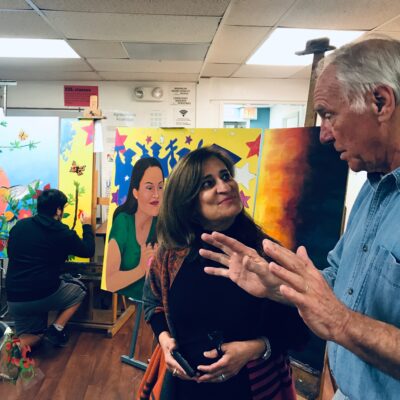
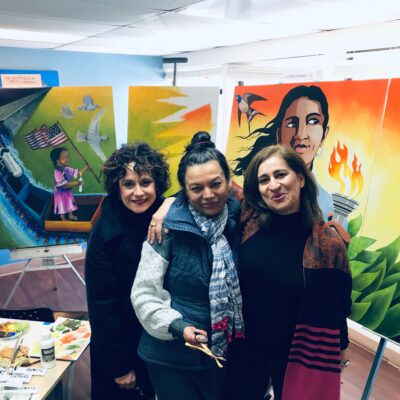
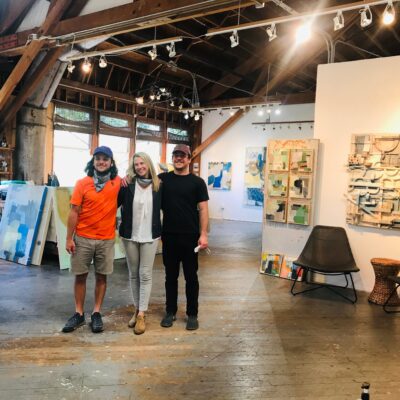
Group collaboration – fun with self portraiture!



Sign up to get our emails.
Connect with us.